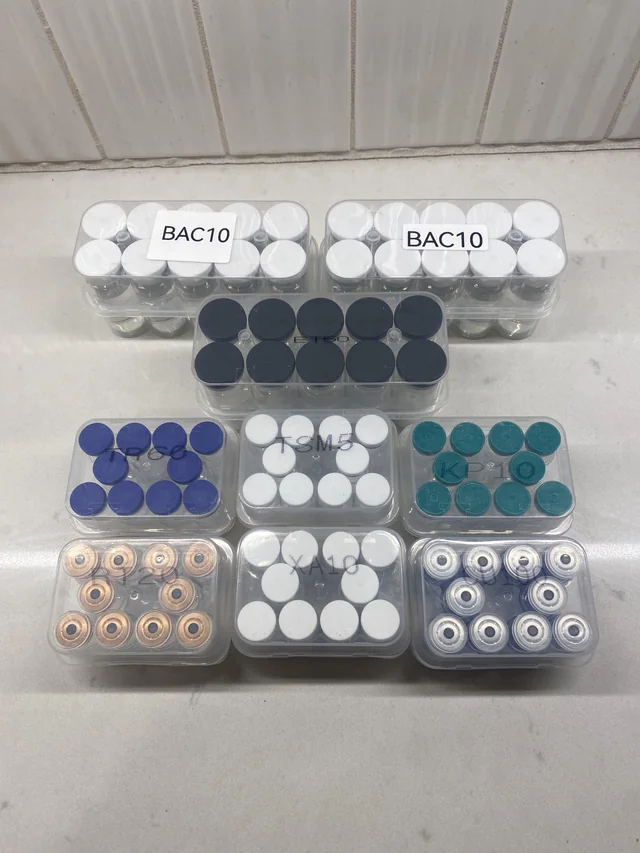
Why Proper Storage Matters
Peptides are sensitive molecules that can degrade when exposed to heat, moisture, light, or oxygen. Proper storage is essential to maintain the purity and activity of research compounds.
Following these guidelines helps keep peptides stable throughout a research project.
Storing Lyophilised Peptides
Lyophilised peptides are the most stable form for storage. Keep them cold, dry, sealed, and protected from repeated temperature changes.
Temperature
- Short term: store at -20°C for weeks.
- Long term: use -80°C for maximum stability over months to years.
- Avoid: repeated freeze-thaw cycles.
Protection from Moisture
- Keep vials sealed until use.
- Let cold vials reach room temperature before opening to prevent condensation.
- Use desiccants in storage containers.
- Work quickly when a vial is open.
Light Protection
- Use original amber vials where provided.
- Store in dark boxes or wrap in foil.
- Keep refrigerators and freezers away from fluorescent light exposure.
Reconstituting Peptides
Choose a solvent appropriate to the peptide and the protocol. Bacteriostatic water is common, sterile water is used for single-use work, dilute acetic acid can help basic peptides, and DMSO is reserved for hydrophobic peptides at minimal volume.
- Calculate the volume needed for the target concentration.
- Add solvent slowly down the vial wall.
- Gently swirl; do not vortex or shake vigorously.
- Allow complete dissolution.
- If cloudiness persists, a small amount of acetic acid may help.
Storing Reconstituted Peptides
Peptides in solution are less stable than lyophilised material. Store at 2-8°C for short periods and use within 2-4 weeks for most peptides. For longer storage, aliquot into single-use portions and freeze at -20°C or -80°C.
Peptide-Specific Considerations
- GHK-Cu: highly hygroscopic, blue in solution due to copper content, and often stable at 4°C for extended periods.
- Cysteine-containing peptides: prone to oxidation; minimise air exposure and consider reducing agents where the protocol allows.
- Large peptides: more sensitive to aggregation and may require specific buffer conditions.
Summary Table
| Storage condition | Lyophilised | Reconstituted |
|---|---|---|
| Room temperature | Days, sealed | Hours |
| Refrigerator, 4°C | Weeks | 2-4 weeks |
| Freezer, -20°C | Months | 1-2 months |
| Deep freezer, -80°C | Years | 3-6 months |
Conclusion
Careful storage and handling are fundamental to reproducible peptide research. For peptide-specific storage questions, our technical team can help review the relevant requirements.